TruLight VS Ambient Lighting
Comparison Table
| Comparison Chart | Trulight | Oleo | Trimlight | Jellyfish Lighting | Everlights | Bosso | Gemstone | Haven X Series | Govee | Omni (Gemstone) | Celebright | Ambient |
|---|---|---|---|---|---|---|---|---|---|---|---|---|
| Price | — | — | — | — | — | — | — | — | — | — | — | — |
| Voltage | 48V | 36V | 12V | 48V | 5V | 12V | 12V | 24V | 36V | 12V | 24V | 48V |
| Lifetime-use Rating | 100,000 Hours | 100,000 Hours | 50,000 Hours | 50,000 Hrs Lights; 22,000 Hrs Controller | 50,000 Hours | 50,000 Hours | 50,000 Hours | 30,000–50,000 Hours | 50,000 Hours | 50,000 Hours | 50,000 Hours | 100,000 Hours |
| Warranty | 5 Year | 5 Years | Lifetime Limited (1 Yr Labor) | 1 Yr Parts & Labor + 5 Yrs Parts | 1 Yr DIY / 5 Yrs Installed | 1 Yr Labor / 5 Yr Material | 1 Yr Labor | 5 Yrs or 30,000 (whichever first) | 3 Yr Limited | Limited Warranty | 1 Yr Labor / 10 Yr Parts | 5 Years |
| Additional Power Supplies Req’d | Every 300 ft | Every 225 ft | Every 50 ft (requires power box) | Every 300 ft | Every 100 ft | 200 ft | ~50–70 ft | ~200 ft | ~200 ft | ~200 ft | ~200 ft | Every 275 ft |
| Lumens (brightness) | 90–120 lm | Up to 11 lm | Up to 30 lm | Up to 27 lm | Up to 24 lm | Up to 72 lm | Up to 46 lm | Undisclosed | 50 lm | Up to 58 lm | 20 lm | Up to 58 lm |
| DIY Option | Yes | Yes | No | Yes | Yes | No | No | Yes | Yes | Yes | Yes | Yes |
| True RGBW (white control) | YES | Yes | No | No | No | Yes | Yes | Yes | Yes | Yes | Yes | Yes |
| Light Spacing | 9" | 10" or closer | 3"/6"/9"/12" | 9" | 9" | 8" | 9" | 9" | 12"+ | 8" | 9" | 9" |
| Track Material | Aluminum | Aluminum/Acrylic | Aluminum | Aluminum | None | Powder-coated Alu | Aluminum | Plastic/Aluminum | 3M & clips | Aluminum | Aluminum | Powder-coated Alu |
| Yellowing on Light | No | No | Yes | Yes | Yes | No | No | No | No | No | No | No |
| Light Style | Puck | Puck | Single LED nipple (3 LEDs) | 3 LED Puck | Single LED nipple | 3 LED Puck (half-moon) | 3 LED Puck (half-moon) | LED strip w/ diffuser | 3 LED Puck | 3 LED Puck | 3 LED Puck | Puck |
| How many wires | 4 | 3 | 3 | 4 | 4 | 3 | 3 | 3 | 3 | 3 | 3 | 3 |
| Diffuser casing | Yes | No | No | Yes | No | No | No | Yes | No | No | No | No |
| Number of LEDs | 6 | 3 | 1 | 3 | 1 | 3 | 3 | ? | 3 | 3 | 3 | — |
Why Voltage Matters in Permanent Holiday Lighting
When it comes to permanent holiday lighting, many companies will claim that “voltage doesn’t matter.” The truth is, voltage is not just important—it’s the single biggest factor that sets lighting systems apart.
There are two main differences between low-voltage systems (5V–24V) and higher-voltage systems like 48V:
So why don’t all companies use 48V? Manufacturing higher-voltage lights requires more investment and higher-quality engineering. Many companies cut corners with cheaper, lower-voltage systems to keep their margins high. While those systems may look cheaper up front, once you factor in the added components, installation complexity, and long-term repairs, the price difference disappears.
With TruLight, you get a 48V system built to last—brighter, stronger, and more reliable than the rest.
RGB vs. RGBW — The Power of True White
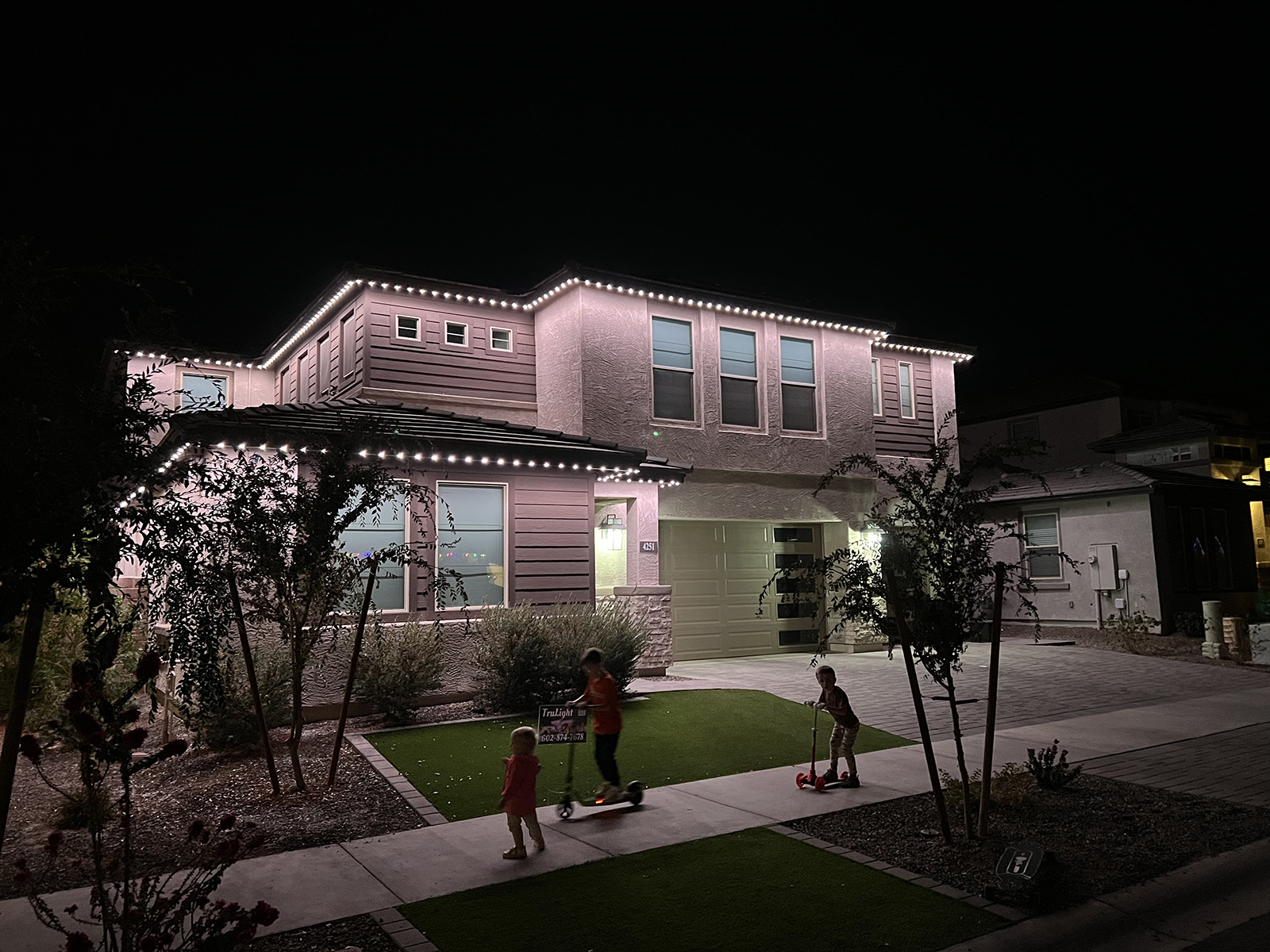
Many lighting companies use RGB systems, meaning each light contains three LEDs: Red, Green, and Blue. When you ask for “white,” the system simply mixes those colors—usually heavy on the blue spectrum—to create what’s often called a “cool white” or “ice white.” It looks okay, but it’s not a true white
At TruLight, we do things differently. Our lights are RGBW, meaning we’ve added three dedicated white LEDs inside each puck. This gives you both:
- The full RGB spectrum (for every color imaginable)
- Plus a True White that looks clean, warm, and natural — not blue-tinted or dull.
In other words, you’re not limited to “close enough” white. You get True White, exactly as it should be — bright, balanced, and beautiful.
You can see the difference instantly. In this example, the home on the left used a competitor’s RGB-only lights. On the right, we replaced them with TruLight RGBW. Side by side, the
Why 4-Wire Systems Matter (and Why TruLight Does It Better)
Most lighting companies use a 3-wire system—a power wire, a ground wire, and a single data wire. They do this because it’s cheaper and easier to produce. But that cost savings comes at the expense of reliability.
At TruLight, we chose to do things differently. Our system uses 4 wires—power, ground, data, and a redundant data line—all in a 16-gauge cable for maximum strength and stability. Yes, it costs more to build, but the benefits to our customers are massive.
Redundant Data = Uninterrupted Performance
In 3-wire systems, if the data line becomes corrupted—whether from a faulty light, bad connection, or weather damage—the entire system can shut down from that point forward. That means one bad light could take out half your house, right before a big holiday or event.
With TruLight’s 4-wire system, that doesn’t happen. The redundant data line keeps the signal moving, so even if a single light or section fails, the rest of your lights stay perfectly lit.
Built for Real-World Reliability
Our 16-gauge wire and dual-data setup are designed to handle long runs and harsh conditions. While others save pennies per foot using thinner wire and fewer connections, we invest more so your lights perform better, last longer, and stay on when you need them most.