TruLight Blog
TruLight vs JellyFish Lighting: An In-Depth Comparison
TruLight vs JellyFish is a matchup of two 48V systems. Both use 16-gauge four-wire cable in aluminum track, and Bowdrie, who presents TruLight's comparison videos, calls JellyFish one of TruLight's closest competitors on hardware. They split on the LEDs, the white light, and what you pay for the controller and music. The bench comparison was filmed in April 2026, and the full video with timestamps is on our compare page.
How TruLight and JellyFish compare
The four wires carry power, data, a redundant data line and ground, so on either system one failed light should not take down the rest of the run. The difference is inside the node. JellyFish has three RGB LEDs. TruLight has six: three RGB and three dedicated warm white.
Does JellyFish have true white light?
No. The JellyFish fixture mixes white from red, green and blue, and that white has a blue tint. Bowdrie calls it "probably the biggest bane, the biggest complaint from most everybody that has it." The video shows a customer's photos of one house with JellyFish lights and then with TruLight. Of the JellyFish photo, Bowdrie says:
"That is not a blue color. We're not trying to make it blue. That is their white."
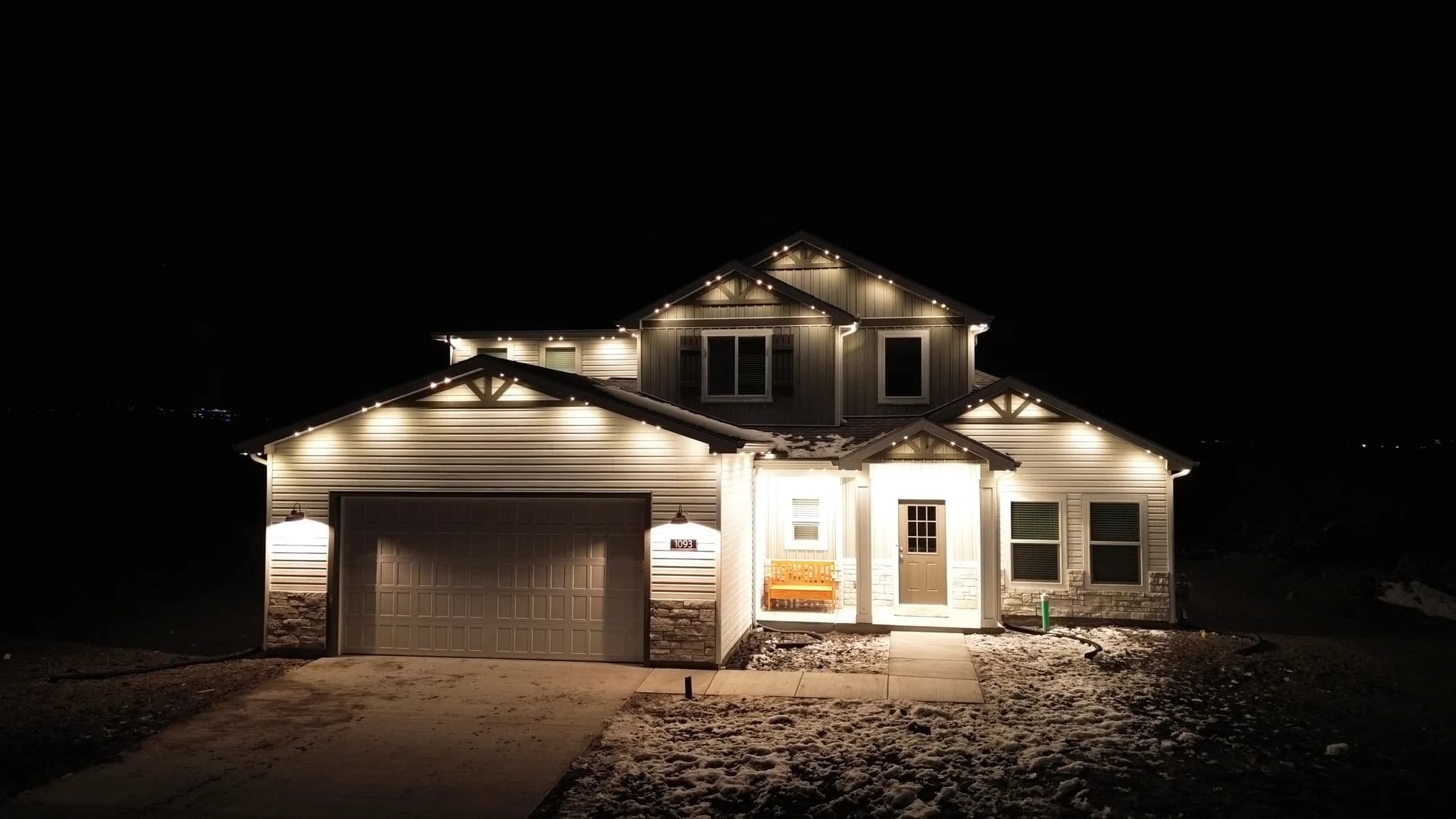
No app update can change that, in his view, because the white LED is not in the fixture. TruLight's warm white LEDs give the house a warm glow, and its pure white lights all six LEDs.
Which LED chip is better: Omega or UCS7604?
Bowdrie's answer is the UCS7604. JellyFish's Omega chip, he says, is an upgraded version of the budget WS2811, reworked for 48V and the redundant data line but still three channels. Both systems show the full RGB color spectrum, about 16 million colors. The UCS7604 adds a fourth channel for the warm white LEDs.
Want to see the side-by-side comparison on your own home?
Why the JellyFish controller costs more
Bowdrie says a lot of a JellyFish quote goes into the control box. In April 2026, the indoor controller sold for $750 and the outdoor version for $850. Music sync needs a separate Music Box at $300, and if an installer comes back to fit it, he estimates another $100 to $150.
"Right then and there, just for the control box to be on your house with music, you're paying $1,300 to have it installed."
TruLight's controller is rated for outdoor use and has music sync built in, so there is no second box to buy, install or plug in.
Full side-by-side specs
Specs and prices as shown in the April 2026 comparison video.
| Feature | TruLight | JellyFish |
|---|---|---|
| LED chip | UCS7604 (RGBW) | Omega (upgraded WS2811, RGB) |
| LEDs per node | 6 (3 RGB + 3 warm white) | 3 RGB |
| True warm white | Yes, dedicated channel | No, RGB blend only |
| System voltage | 48V | 48V |
| Wire gauge | 16 gauge | 16 gauge |
| Wiring system | 4-wire redundant data | 4-wire redundant data |
| Puck profile | 37mm, lower profile | 30mm wide, sticks out further |
| LED-hour figure cited in video | 100,000 hours | 50,000 hours |
| Warranty | Limited lifetime | 5 years |
| Indoor controller cost | Quoted by your dealer | $750 |
| Outdoor controller option | Standard: controller is outdoor rated | $850 add-on |
| Built-in music sync | Yes, beat-data detection | $300 Music Box add-on |
| Patterns | Thousands of patterns, 144 effects | 9 base + layered effects |
| Density control | Yes | No |
| Animated house preview | Yes | No |
| True global zoning | Yes | Yes |
| Dedicated motion sensors | Yes, as an add-on | No (Alexa/Google/Ring integration only) |
| App history | One app, pushed updates | 5+ apps over time |
How does music sync work?
Bowdrie says JellyFish promised music for years and delivered it only with a brand-new app and the $300 Music Box. The box listens through a microphone or takes an audio cable from a sound system, then matches the lights to the beat. He counts about seven music patterns.
TruLight's music sync is part of the controller. You upload songs to the music manager, the system reads the beat data in each track, and the lights hit those beats. A microphone mode handles live sound.
Motion sensors and HOA review
You can add TruLight motion sensors to the system, and a sensor turns on an assigned zone when someone walks by or a package lands on the porch. JellyFish works with Alexa, Google and Ring doorbells, as TruLight does, but Bowdrie knows of no dedicated JellyFish motion sensor. He also says sensors help with HOAs: lights that respond to motion read as security lighting, and HOAs "are more inclined to allow approvals." See our motion-lighting guide.
Zoning: one of JellyFish's strengths
Bowdrie separates real zoning, where each zone shows its own pattern at the same time, from simply selecting a group of lights. JellyFish has the real thing: make lights 87 to 94 a zone, and it can do one effect while the rest of the house does another. "Props to JellyFish," he says. TruLight zones work the same way, with pattern direction and sensor assignments set per zone.
Build quality and ratings
Bowdrie rates the two builds as very similar. Both lenses have a smoky diffuser, so the light bounces around inside the puck and washes down the wall as an even flood instead of a hard spotlight. The visible difference is profile: he says the JellyFish puck sticks out almost double the distance, so you see the bumps more along the roofline.
TruLight's lights carry an IP67 rating, and the system is UL listed. Dealer-installed TruLight systems include a limited lifetime warranty on the lighting modules and control box, with registration, claims and exclusions on the warranty terms page.
Ready to see what TruLight looks like on your home?
Using the app day to day
JellyFish's current app has nine base animations, such as chase and fireworks, with effects like lightning and twinkle layered on top. Bowdrie calls its training videos "really well done," but there is no preview of an effect on a house. TruLight's app has thousands of patterns, 144 effects, density control and an animated house preview.
His biggest complaint is churn. He says JellyFish has gone through five or more separate apps, each one a fresh download. TruLight pushes updates through the same app.
Frequently asked questions
Is JellyFish worth the higher controller price?
Bowdrie's view is that JellyFish is "a good system" that "lacks some pretty key components," chiefly a white LED and dedicated motion sensors. With the controller and Music Box near $1,300 installed in the April comparison, he says TruLight's controller costs less and already includes music.
Can I watch the full TruLight vs JellyFish video?
Yes. The full 30-minute comparison is on our TruLight vs JellyFish comparison page, with timestamps for the hardware, LED chips, white light, controller pricing, music sync, app, zoning and motion sensors.
What to ask your dealer
- Does each node have a dedicated warm white LED? Light warm white and pure white on a sample so I can see both.
- What does the controller cost, and is music sync built in or a separate box?
- Will the controller go inside the garage or outside, and what is it rated for?
- Can two zones show different patterns at the same time? Show me in the app.
- Do you offer motion sensors, and which zones can a sensor turn on?
- How often has the app been replaced, and will my settings carry over to the next version?
- Is financing available, and can the warranty move to a buyer if I sell the house?