Video Comparison
TruLight vs Bosso: The Full Breakdown
Bosso is a newer company with a slick, modern app. Its light uses a familiar protruding three-lens form, and Bosso publishes older WS2811 electronics at 12V. When we filmed this comparison in May 2026, Bosso charged $15 to $20 per month for paid app tiers. Bosso now advertises a free app with no subscription. Here is the hardware comparison, the app policy we documented then, and what has changed since filming.
*Update, August 13, 2026: This video was recorded on May 23, 2026 and accurately shows Bosso's Free, Premium, and Deluxe app tiers at that time, including fees of $15 to $20 per month for certain features. Bosso now advertises its app as free with no subscription. We have left the original video unchanged so viewers can see the product and pricing we reviewed when it was filmed. App terms can change, so confirm current details directly with Bosso before purchasing.
Jump to a Section
Here's the Bottom Line
Bosso built a genuinely modern app, and we will give them credit for that. Its visible three-lens puck resembles a widely sold OEM form factor. The owner-supplied Bosso sample confirms that exterior design, but not every supplier or internal component. As of August 2026, Bosso advertises its app as free with no subscription. That is a meaningful change from the paid tiers documented in our May video. The hardware comparison remains the same: Bosso's published material identifies a 12V system using the older WS2811 chip, while TruLight uses a 48V UCS7604 RGBW system with a dedicated white channel.
Limited Lifetime Warranty. Full warranty details
Bosso Changed Its App Terms
Our May 2026 video documents Bosso's former Free, Premium, and Deluxe tiers, including paid access to app features. Bosso now advertises the app as free with no subscription. Both the earlier policy and the current offer are relevant when comparing the companies.
48V vs 12V, 6 LEDs vs 3
TruLight runs at 48V with the UCS7604 RGBW chip, 6 LEDs per node, and a 100,000 hour rating. Bosso runs the older WS2811 chip at 12V, with 3 LEDs and a 50,000 hour rating. Its visible three-lens form resembles a puck design sold by many suppliers, but the published internals and lifespan are what matter.
TruLight's App Policy Has Stayed Consistent
TruLight does not charge a monthly fee to unlock app features. Bosso's current no-subscription offer now matches that part of the TruLight model, although Bosso previously used paid app tiers.
Full Side-by-Side Specs
| Feature | TruLight | Bosso |
|---|---|---|
| LED Chip | UCS7604 (RGBW) | WS2811 |
| LEDs Per Node | 6 full LEDs (3 RGB + 3 warm white) | 3 LEDs |
| True Warm White | ||
| True Pure White | ||
| Expected Lifespan | 100,000 hours | 50,000 hours |
| System Voltage | 48V | 12V |
| Build Feel | Thicker wire, solid housing | Thin wire, plastic housing |
| Power Injection | Roughly every 400 lights | More frequent (low voltage) |
| Motion Patterns | 144+ | 26 |
| Holiday Presets | Thousands | 24 |
| App Subscription | None, all features free | None advertised currently |
| App Advertising | No ads | Not stated on current app page |
| Music Sync | Included free | Advertised free currently |
| Smart Home (Siri/Google/Alexa) | Included free | Advertised free currently |
| Optional Protection Plan | Limited lifetime warranty | Bosso Premium |
| True Global Zoning | Limited | |
| App Store Rating at Filming | 4.6 stars | 3.7 Google Play |
*LEDs Per Node: Bosso's three LEDs are not RGB only. Each diode is split into a color section and a smaller warm white section, which is why it can produce a real warm white. TruLight uses three separate full-size warm white LEDs in addition to the three color LEDs.
*True Warm White: Both systems produce a genuine warm white. Theirs comes from a smaller warm white section inside each color diode, often marketed as a "quarter light." TruLight's is typically brighter because three full-size warm white LEDs at 48V put out more than three quarter-size sections at 12V.
*True Pure White: Pure white comes from driving the three color LEDs to a cool white with three dedicated warm white LEDs lifting underneath, all six at once. A warm white section that shares a color diode does not have the output to do that.
*Expected Lifespan: The WS2811 is an older chip rated at 50,000 hours. The UCS7604 in TruLight is rated at 100,000 hours, double the lifespan.
*Build Feel: In the video we hand both lights to people at trade shows. The most common reaction to the Bosso puck is that it feels cheap. The wire is noticeably thinner and the housing is plastic.
*Power Injection: A 12V system cannot carry power as far on a single run, so it needs power injected far more often than a 48V system. More injection points means more splices.
*App Subscription: When this video was recorded in May 2026, Bosso offered Free, Premium, and Deluxe tiers at $15 to $20 per month. As of August 13, 2026, Bosso advertises its app as free with no subscription.
*App Advertising: The May 2026 video documents customer reports of forced ads in Bosso's free tier at that time. Bosso's current app page does not state whether the app contains advertising.
*Music Sync: Music sync appeared behind Bosso's paid tier in the May 2026 video. Bosso now lists music sync among the features of its free app.
*Smart Home (Siri/Google/Alexa): These integrations appeared behind Bosso's paid tier in the May 2026 video. Bosso now lists Alexa, Google Assistant, and Siri among the features of its free app.
*Optional Protection Plan: Bosso currently describes Premium as an optional hardware protection, warranty, and priority-service plan. Bosso says it is separate from app access and not required to use the app.
*True Global Zoning: Bosso lets you turn a zone off, but it is not clear you can run two zones on different patterns at the same time. TruLight and JellyFish are the two systems that do real global zoning.
*App Store Rating at Filming: These ratings were shown in the May 2026 video and are historical, not current ratings.
The Light: Photographed Side by Side
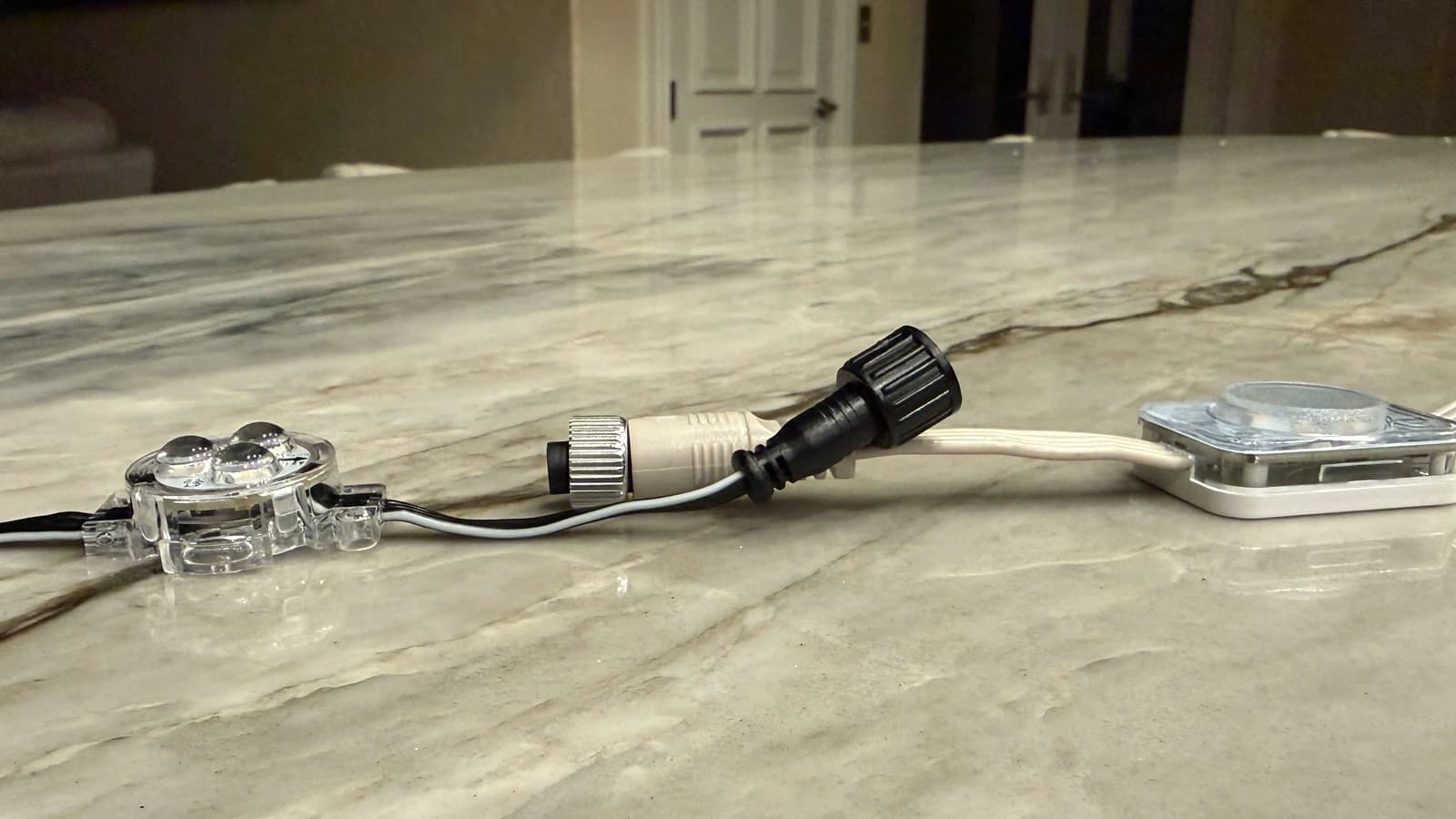
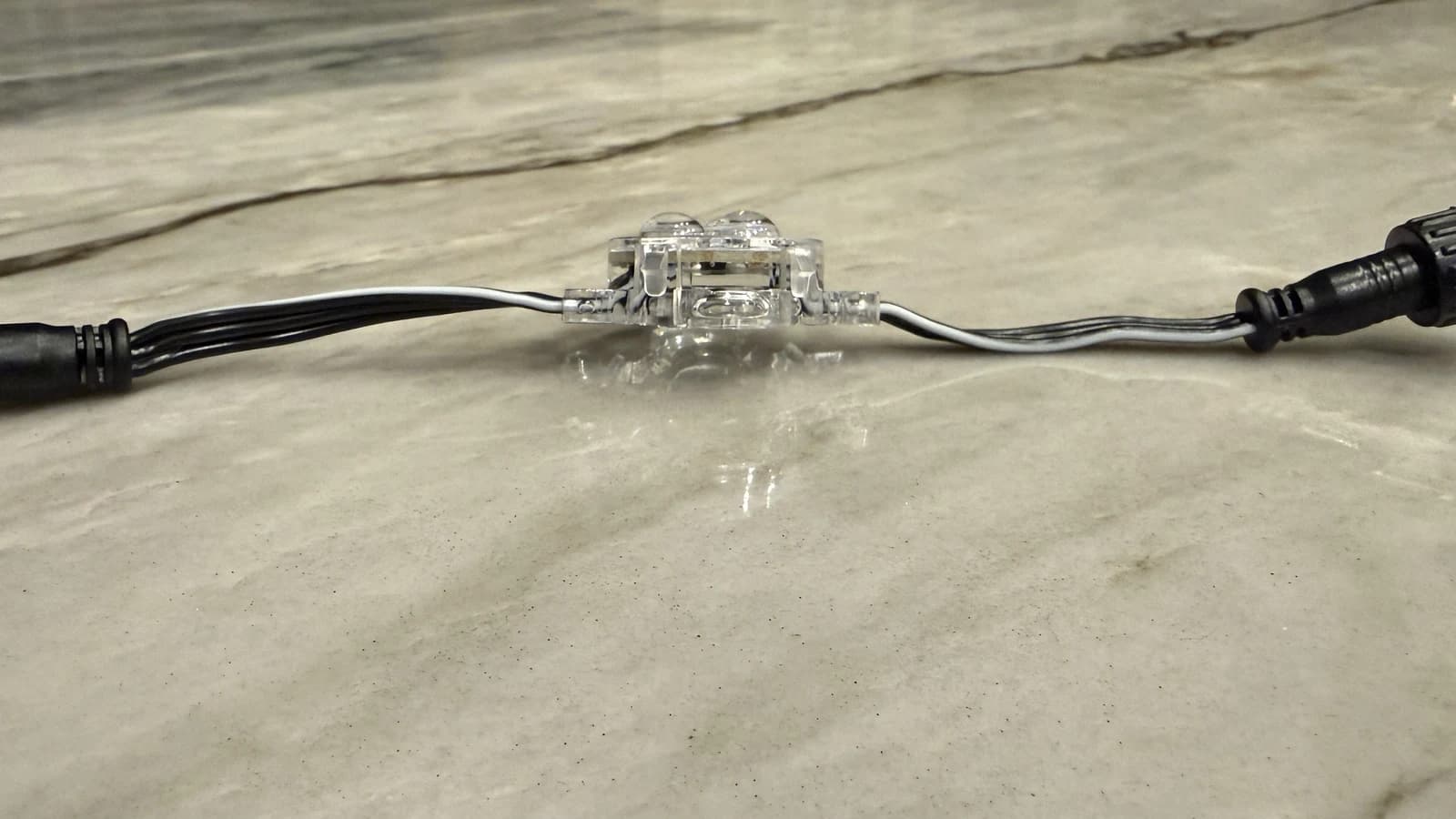
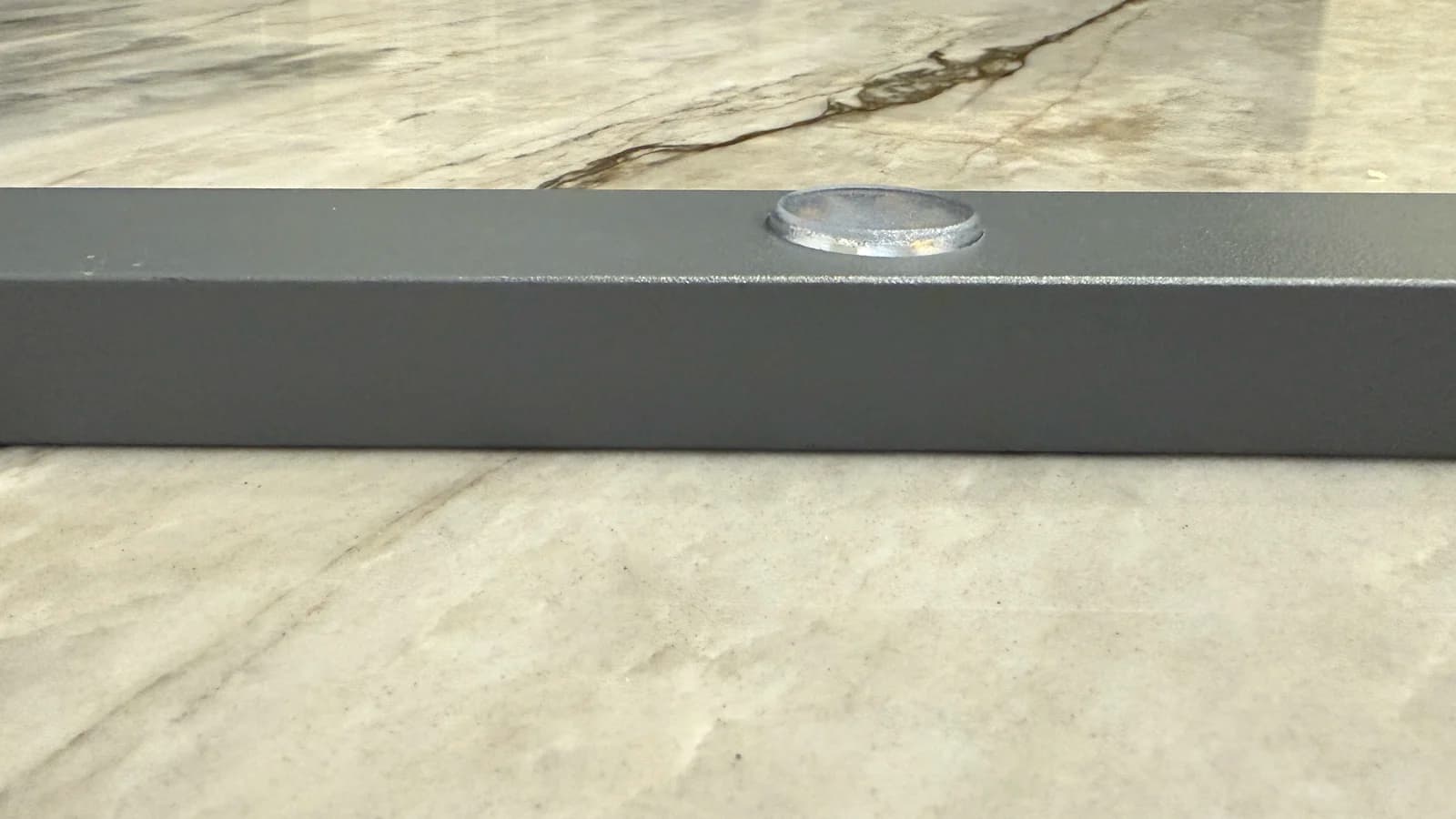
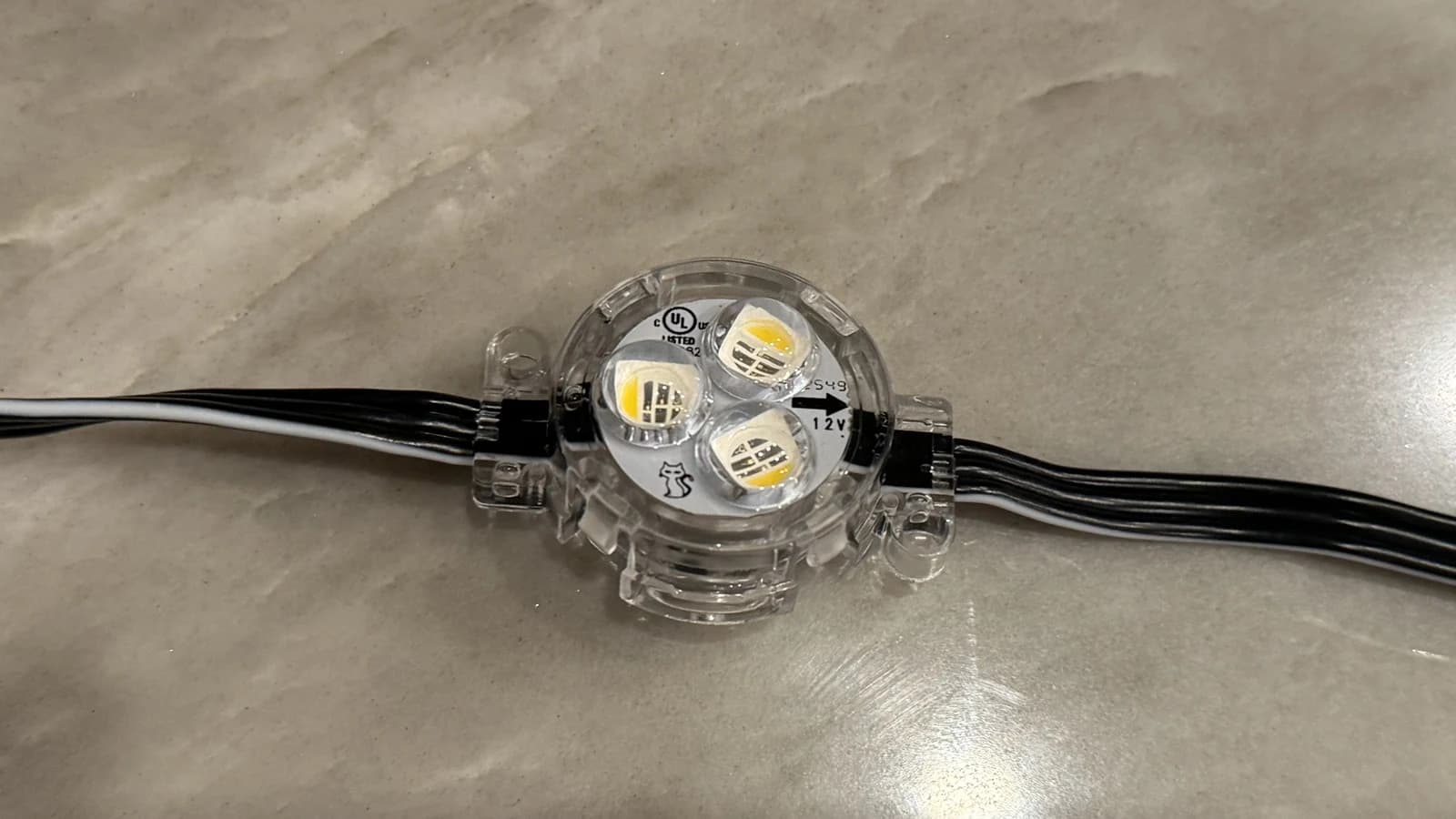
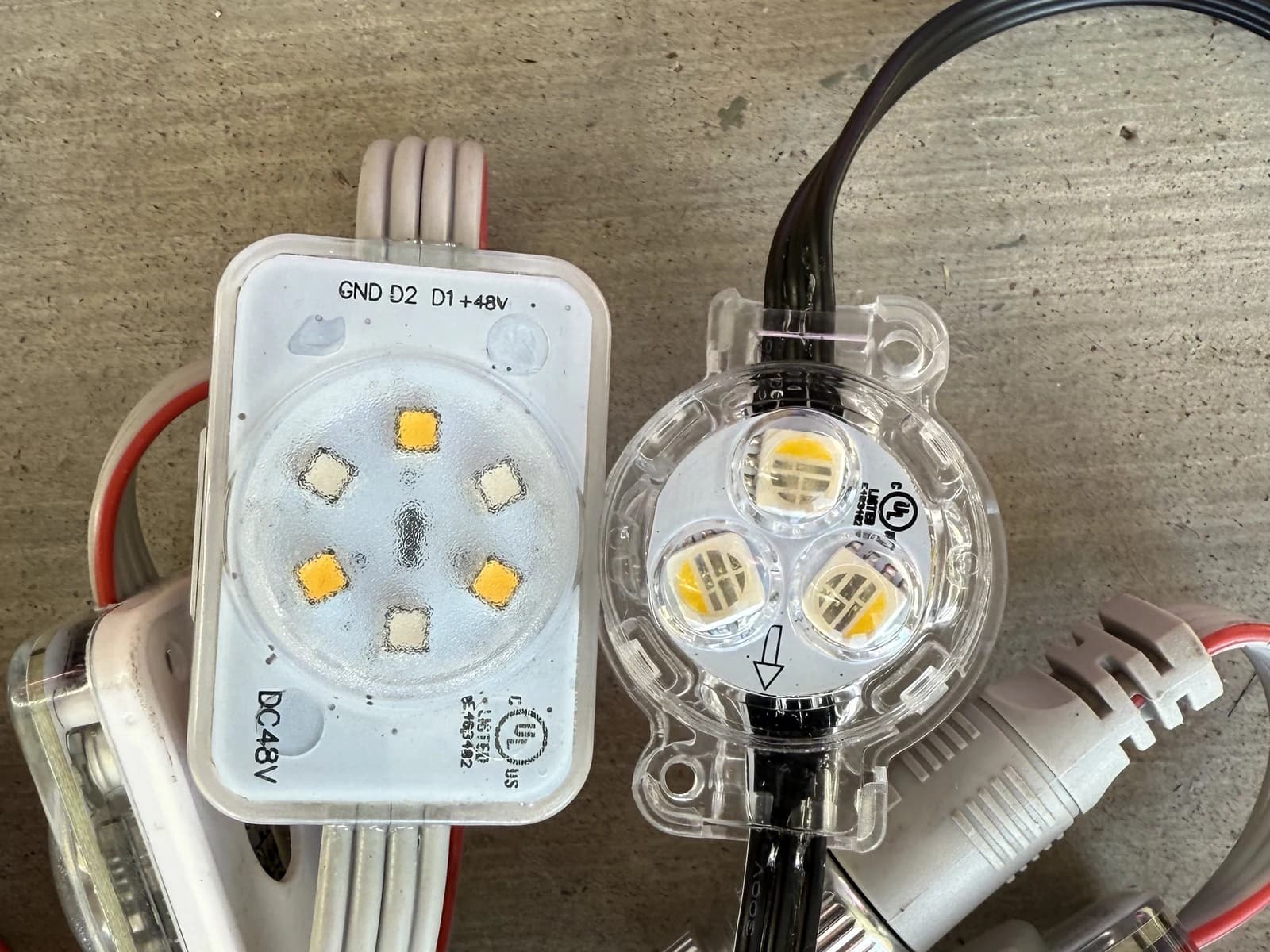
We bought the Bosso hardware shown below and photographed it beside a TruLight node. The markings identify the Bosso unit as 12V and the TruLight unit as 48V. The Bosso node has three emitters under raised clear lenses. The TruLight node has six visible emitters behind one diffused face.
The Bosso housing uses the same round, three-lens puck form shown in the Gemstone dealer video. The appearance is a close match, but these photos do not establish that every internal component or supplier is identical. What they do show clearly is the difference in node shape, lens profile, emitter count, wiring, and voltage marking.
WS2811 vs UCS7604: Which Chip Is Better?
Bosso runs the WS2811. It is a well known chip and it was the best on the market when it came out years ago. But it is an older 8-bit design, which is part of why these lights are rated at 50,000 hours.
TruLight uses the UCS7604, a 4-channel RGBW chip with a dedicated warm white channel built in. That gives you 6 LEDs per node, 3 RGB plus 3 warm white, a real warm white that flatters stone and stucco, and a 100,000 hour rating. To be clear about what Bosso can do: it produces a real warm white of its own, from a smaller warm white section built into each of its three diodes. The difference is output and range. Three full-size warm white LEDs at 48V run brighter than three quarter-size sections at 12V, and only the six-LED layout can also blend a true pure white.
Do not take our word for it. Google “WS2811 vs UCS7604” yourself and read what comes up. In the video, we run that exact search live on camera.
See the chip comparison at 7:34 in the videoBuild Quality: Thin Wire and a Plastic Housing
When we go to trade shows, we hand people a Bosso light and a TruLight light and ask them to tell us what they feel. The reaction is almost always the same: the Bosso puck feels cheap. The wire is thinner, the housing is plastic, and the cap pops off by hand. A 12V system does not need the heavier components that a 48V system does, so the build comes out lighter and thinner.
TruLight uses a thicker 16-gauge wire and a more solid fixture. You can feel the difference the moment you hold both. These lights live on your house through every season for years, so build quality is not a small thing.
See the hands-on build comparison at 5:27 in the video12V vs 48V: Why It Changes the Install
Bosso runs at 12V. TruLight runs at 48V. This matters for install complexity, not brightness. A lower voltage system cannot carry power as far on a single run, so installers have to splice in power injection points far more often to keep the lights consistent across the house.
TruLight covers about 400 lights per injection on a single 48V run, from one box with one data source. Every injection point is one more splice and one more potential fail point down the road. Fewer points means fewer things to go wrong over the life of the system.
See the voltage breakdown at 3:31 in the videoWhat Bosso Charged When We Filmed
In May 2026, Bosso divided its app into Free, Premium, and Deluxe tiers. The paid plans shown in our video cost $15 to $20 per month and placed features such as music sync, smart-home control, and the AI assistant behind those plans.
The video also shows the customer reviews available at the time, including reports that the free tier required people to watch three ads before changing their lights. At $20 per month, the highest tier would have cost $240 per year. Those statements describe Bosso's app and published customer experience when the video was recorded. They do not describe Bosso's current advertised offer.
As of August 13, 2026, Bosso says the app is free to download and use with no monthly or annual app fee. Bosso still advertises an optional Premium hardware-protection and service plan, but says that plan is separate from app access. We think the earlier decision to charge for access is still relevant history for a long-term product attached to a home, just as Bosso's decision to remove that fee is relevant to its current offer. Ask both companies to put current app access and fees in writing before you buy.
See the May 2026 app-tier breakdown at 15:43The App: 26 Patterns vs 144+
Credit where it is due: Bosso's app is modern and easy to use. It has 24 holiday presets, 26 moving patterns, scheduling, sunset and sunrise timers, and a clean layout. Bosso now advertises music sync and voice control as part of its free, no-subscription app.
TruLight's app has 144+ motion patterns and thousands of presets, more than five times the moving patterns Bosso offers. Every pattern shows an animated preview on a sample house right inside the app, so you can see it before you turn the lights on, and nothing is locked behind a subscription.
TruLight App
- 144+ motion patterns
- Thousands of presets
- Animated house preview
- True global zoning, free
- Music manager, free
- Smart home control, free
- No subscription, ever
Bosso App
- 26 motion patterns
- 24 holiday presets
- Scheduling and timers
- Music sync advertised free
- Voice control advertised free
- No subscription advertised now
- Paid tiers documented in May 2026
Zoning: Turning Zones Off vs True Global Zoning
Bosso has zoning, and it is a step ahead of the older companies. You can select a section of lights and turn it off, which is handy if a window zone shines into a bedroom at night. What is not clear from the app is whether you can run two zones on two different patterns at the same time, which is the part that actually matters most.
With TruLight, you can set the front of the house to a Christmas pattern and the back of the house to a soft two-on, two-off accent at the same time, then save it. You can tell the system that a specific stretch of lights should always reverse direction on any pattern. In the whole industry, TruLight and JellyFish are really the only two doing real global zoning like that.
See the zoning demo at 13:25 in the videoYou Own Your TruLight System. No Subscriptions, Ever.
When TruLight launched, we did not have zones, music, or smart home control either. We have added all of it over time, and we have charged our customers exactly nothing to use those features. The only thing that ever costs extra is the motion sensor, because that is a separate piece of hardware. Using it in the app is free.
That is the promise: TruLight will not paywall you. You paid premium dollars for a premium system, so it should be yours. Everything Bosso offers, TruLight offers too, music, zoning, smart home control, more patterns, more presets, and we do not charge a monthly fee to unlock any of it.
See the no-paywall promise at 27:01 in the videoStraight From the May 2026 Video
“If you want to change the color of your lights, you have to watch three videos before you can actually control your lights. That's insanity.”
“This pricing model means you do not own your system. You do not own your lights.”
“We will not charge you for features inside the app. This is your system. You paid for it, so it should be yours.”
Ready to See the Difference?
Find your nearest TruLight dealer for a quote. A 48V RGBW system, 144+ patterns, and every app feature included, free, on a system you own outright. No monthly subscription to use your own lights.