Video Comparison
TruLight vs Gemstone: 48V vs 12V, 6 LEDs vs 3
Gemstone is one of the most-asked-about competitors. Same retail price, very different hardware. The voltage gap, the chip difference, and the app feature gap add up to a system that performs in a different category.
Here's the bottom line
Gemstone runs a 12V system while TruLight runs 48V. That voltage gap is the biggest physical difference between the products. Add 27 patterns vs 144+, different white-light hardware, and more frequent power injection on the 12V design, and the systems perform differently even when quotes are similar.
2x the LEDs
TruLight uses 6 LEDs per node: 3 RGB plus 3 dedicated warm white. That hardware supports both warm white and a bright pure-white mode.
48V vs 12V
Higher voltage means fewer power injection points, simpler installation, thicker wiring, and consistent brightness across longer runs.
144+ Patterns vs 27
Plus density control, background coloring, animation previews, true global zoning, and motion sensors. The app is where TruLight pulls ahead.
Full side-by-side specs
| Feature | TruLight | Gemstone |
|---|---|---|
| LED Chip | UCS7604 (RGBW) | WS2811 |
| LEDs Per Node | 6 | 3 |
| True Warm White | ||
| True Pure White | ||
| System Voltage | 48V | 12V |
| Wire Gauge | 16 gauge (thicker) | 18 gauge (thinner) |
| Wiring System | 4-wire (redundant data) | 3-wire |
| Expected Lifespan | 100,000 hours | 50,000 hours |
| Power Injection | Every 400 lights | Every 50 to 70 lights |
| Signal Redundancy | ||
| Motion Patterns | 144+ | 27 |
| Density Control | ||
| Background Coloring | ||
| App Animation Preview | ||
| True Global Zoning | ||
| Motion Sensors | ||
| Music Sync | Music manager + Bluetooth | Phone mic + local WiFi |
*True Warm White: Both systems produce a genuine warm white. Gemstone's comes from a smaller warm white section inside each color diode, which they market as a "quarter light." TruLight's is typically brighter because three full-size warm white LEDs at 48V put out more than three quarter-size sections at 12V.
*True Pure White: Pure white comes from driving the three color LEDs to a cool white with three dedicated warm white LEDs lifting underneath, all six at once. A warm white section that shares a color diode does not have the output to do that.
*Signal Redundancy: If a WS2811 light fails, the signal stops at that point. The UCS7604 has built-in chip redundancy plus a 4th backup data wire.
*True Global Zoning: Gemstone supports light selection and grouping, but not independent global zones with reverse patterns and separate controls.
Limited Lifetime Warranty. Full warranty details
What does the physical puck profile look like?
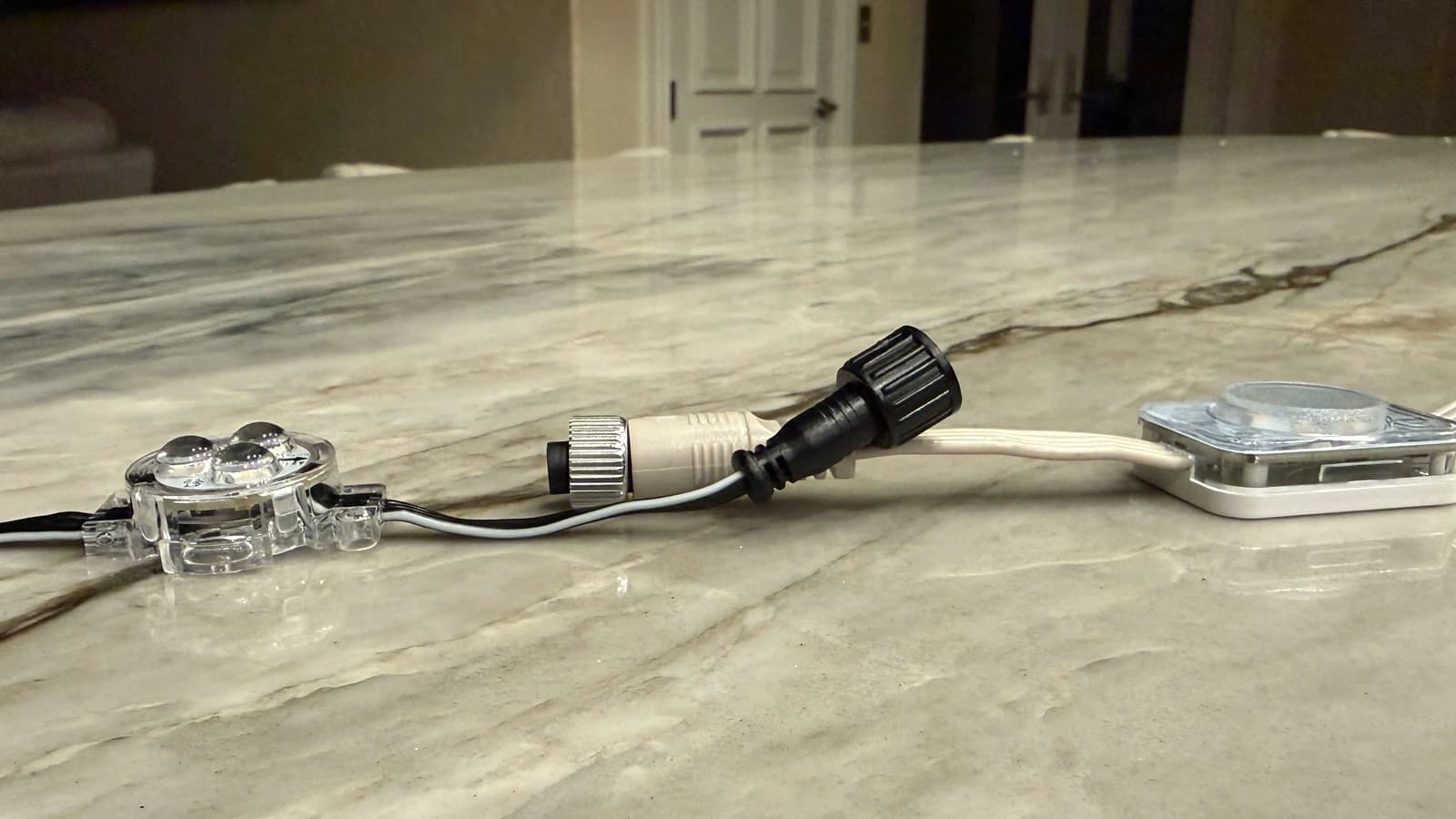
We photographed a purchased Bosso node beside a TruLight node at the same camera height. Bosso is on the left. TruLight is on the right. The raised three-lens Bosso housing uses the same visible form shown in the Gemstone dealer walkthrough. This is not a Gemstone product sample, and the photo does not establish that every internal component is identical.
The three-lens 12V puck is also sold as a general permanent-track-light form factor. Current supplier listings advertise 12V, 30 mm RGBW point lights with three LEDs for permanent track installations. Similar exterior shapes do not mean the controller, track, warranty, app, or internal electronics are identical.
See a current 12V three-LED permanent track light supplier listing
Why voltage matters more than spec sheets suggest
Voltage is the most underrated spec on every permanent lighting comparison sheet. Most homeowners read 12V vs 48V and assume voltage is just a number. In practice, the voltage rating dictates how far a single circuit can run, how often you need power injection points, the wire gauge needed for safety, and how consistently brightness holds up across a long run.
A 12V system needs power re-injected every 50 to 70 lights to maintain brightness. That means more transformers in your soffit, more drilled holes, more potential failure points, and more visible hardware. A 48V system can run 400+ lights on a single circuit without re-injection. Cleaner install. Fewer points of failure. More uniform brightness from the first light to the last.
See the voltage breakdown at 9:34What does Gemstone's white light actually look like?
Gemstone offers warm-white output. Product generations and hardware configurations can vary, so confirm the exact light included in a current quote.
TruLight has 3 dedicated warm-white LEDs in every light, separate from the 3 RGB LEDs. That six-emitter design supports warm white plus a bright pure-white mode. TruLight co-owner Tom Porter says pure white is the setting customers most often tell him they use. This is owner-reported feedback, not app telemetry.
See the white light comparison at 4:12Patterns, zoning, and the app feature gap
Gemstone's app has 27 motion patterns. TruLight has 144+, plus density control to tune how busy each pattern looks, plus background coloring so you can layer effects, plus an animated house preview that lets you see scenes on a virtual roofline before you turn the lights on.
On zoning, TruLight has true global zones that can each run independent patterns simultaneously. Gemstone supports light selection and grouping, but does not run multiple zones at once with their own patterns and reverse-direction controls.
See the app comparison at 18:48Same price. Different category.
Gemstone is a real product. TruLight is a different category of product at the same retail price. Find your nearest dealer to see both side by side if you can.